



Key Takeaways
- Full-arch dental implants replace an entire upper or lower set of teeth using implants that support a bridge or prosthesis.
- “Same-day” commonly refers to a temporary fixed restoration placed after surgery, not necessarily the final teeth.
- Bone health, gum health, medical history, smoking, bite forces, and home-care habits all influence treatment planning.
- Implants require lifelong cleaning and professional follow-up, even when the teeth do not come out.
- A detailed consultation and, when appropriate, a second opinion can help patients compare irreversible treatment choices.
Replacing most or all teeth is a major decision that affects eating, speaking, appearance, comfort, and daily routines. For people in Maple Grove and the wider Twin Cities area, same-day teeth with dental implants may sound like a quick solution, but successful full-arch treatment requires careful diagnosis, realistic expectations, healing time, and long-term maintenance.
Whether tooth loss developed gradually or dentures have become difficult to wear, a thoughtful evaluation can help determine whether a fixed implant-supported arch, a removable option, or another treatment is a better fit for your health, goals, and budget.
Why People Consider Full-Arch Dental Implants
Replacing a full arch differs from replacing one missing tooth. The goal is to restore a complete row of teeth and a stable bite, often for people with extensive decay, advanced gum disease, many failing teeth, or no remaining natural teeth. Common concerns include loose dentures, difficulty chewing Minnesota favorites such as crisp apples or corn on the cob, changes in speech, sore spots, and feeling self-conscious in social or professional settings.
Fixed implant-supported teeth are attached to implants in the jaw, while conventional full dentures rest on the gums and are removable. Neither option is automatically right for everyone. A useful treatment discussion addresses function, appearance, comfort, cost, repair needs, and ease of cleaning the restoration.
How Full-Arch Treatment Works
Dental implants are small posts placed in the jawbone to support replacement teeth. In full-arch care, several implants are positioned to support a connected upper or lower restoration. The replacement teeth may be called a fixed bridge, full-arch restoration, or implant-supported prosthesis.
There are usually separate stages: implants, an early temporary restoration when appropriate, and a final restoration after healing and bite adjustments. The number, angle, and location of implants vary based on bone availability, jaw anatomy, bite forces, opposing teeth, and the planned tooth design. The final bite should guide the surgical plan rather than be treated as an afterthought.
Who May Be a Good Candidate?
People with multiple failing teeth or complete tooth loss may be candidates, but candidacy is determined on an individual basis. The clinician must assess gums, bone, infection, medical conditions, medications, oral hygiene, and the ability to attend follow-up visits. Smoking, uncontrolled health conditions, active periodontal disease, and significant teeth grinding can complicate treatment or change the recommended approach.
Some patients need extractions, gum treatment, bone grafting, or time for healing before implants can be placed. Others may be able to proceed with immediate loading. Only an in-person exam and diagnostic review can establish whether a particular plan is appropriate.
The Consultation and Digital Plan
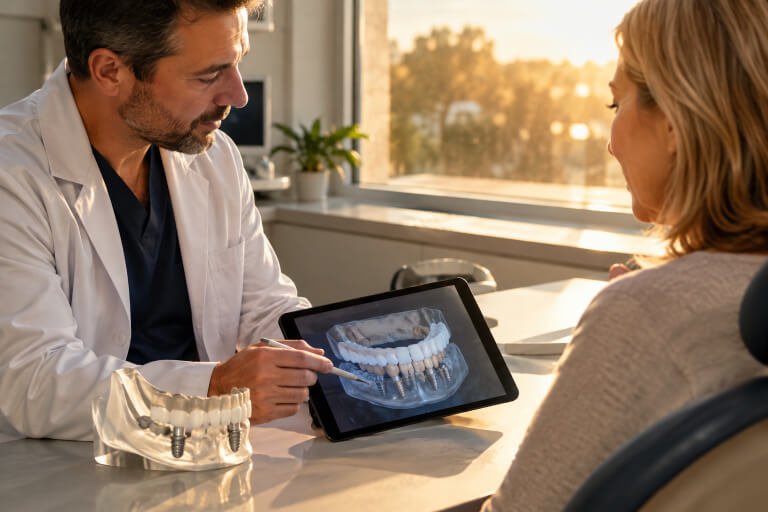
A comprehensive consultation should be a two-way conversation, not a sales presentation. It commonly includes a review of dental and medical history, current medications, an exam of the mouth and bite, photographs, digital scans, X-rays, and sometimes 3D imaging. Bring a medication list, prior dental records if available, and written questions.
What Digital Planning Can Show
Three-dimensional imaging can help the team evaluate bone volume and important structures such as nerves and sinus spaces. Digital planning may also connect the desired tooth position with implant placement. Before surgery, ask to review the proposed implant locations, expected healing stages, temporary and final materials, need for grafting, and the backup plan if an implant does not achieve adequate stability.
What “Same-Day Teeth” Usually Means
Same-day treatment often means a temporary fixed set of teeth is placed soon after implants are inserted. It does not necessarily mean the final teeth are delivered that day. Temporary teeth may differ in material, contour, strength, and appearance from the final restoration.
Immediate loading depends on factors including implant stability, bone quality, surgical findings, and bite pressure. Not every patient qualifies. Ask exactly what will be placed on surgery day, whether it is fixed or removable, what it is made of, and how long it is expected to be worn.
Recovery and Healing
Early recovery may include swelling, tenderness, bruising, fatigue, and temporary speech changes. A soft-food diet is commonly recommended while the surgical sites and implants heal. Follow the treating team’s instructions about medication, cleaning, exercise, smoking, and appointments rather than relying on general advice from friends or social media.
The visible recovery period is only one part of healing. Implant integration with bone and the transition to a final restoration may take longer. Contact the dental office promptly for worsening swelling, uncontrolled bleeding, fever, severe pain, a loose restoration, or any concern that feels urgent.
Daily Care and Long-Term Maintenance
Full-arch restorations still require daily plaque control around the gums and underneath accessible portions of the teeth. As professional maintenance guidance for full-arch restorations explains, follow-up care should include monitoring the surrounding tissues, plaque accumulation, bite, and the mechanical condition of the prosthesis.
- Brush the restoration and gumline as instructed.
- Use floss tools, interdental brushes, or water irrigation devices when recommended for the restoration design.
- Keep regular hygiene and implant-review appointments based on personal risk factors.
- Report bleeding, swelling, bad taste, changes in fit, or unusual movement.
- Use a nightguard or other protective measure if advised for grinding or heavy bite forces.
Risks, Questions, and Alternatives
Full-arch implant treatment is substantial care, not a guaranteed one-day fix. Biological complications can include inflammation around implants, bone loss, or implant failure to integrate. Mechanical issues can include worn materials, chipped teeth, loose screws, or damage to a temporary restoration. An evidence-based consensus review of full-arch implant rehabilitation emphasizes patient selection, prosthetically driven planning, risk-based maintenance, and long-term follow-up.
Questions Worth Asking
- Which restoration is recommended, and why?
- How many implants are planned for each arch?
- Will I receive temporary or final teeth on the day of surgery?
- Will I need grafting, periodontal treatment, or extractions?
- What happens if an implant does not heal as expected?
- Which fees include surgery, temporary teeth, final teeth, maintenance, and future repairs?
Conclusion
Alternatives may include conventional dentures, removable implant-retained overdentures, individual implants, bridges, or partial dentures. Compare stability, cleaning demands, treatment time, repair needs, and long-term costs. For an extensive and irreversible treatment plan, seeking a second opinion can be a sensible part of making an informed decision.