




Core Phases of Successful Web Development Projects
Managing a modern web development project feels a lot like building a skyscraper. You need a rock-solid foundation, a clear blueprint, and the right tools to bring the vision to life without the structure collapsing under its own weight. I have spent years navigating the complexities of sprint cycles, API contracts, and system architectures, and I have learned that the most successful projects prioritize more than just clean code. They prioritize the people writing that code.
If you are a developer or a project lead, you know that your physical environment is just as vital as your tech stack. We often spend hours locked into our workstations, hyper-focused on solving logic puzzles, while ignoring the physical toll that static posture takes on our bodies. Just as a project requires structural integrity to scale, your body requires proper support to maintain the cognitive endurance needed for long-term output. It is easy to overlook how simple adjustments—like optimizing your chair, monitor height, or even your footwear with arch support inserts—can impact your daily comfort and focus.
In this guide, I will break down the essential phases of a web development project, from initial discovery to final deployment. I will also explore how to balance technical excellence with the ergonomic habits necessary to prevent burnout and keep your team performing at their best. Whether you are scaling a microservices architecture or managing a tight release timeline, the path to a successful build starts with a sustainable approach to both your code and your well-being.
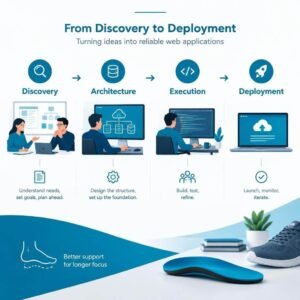
Every successful project follows a rhythm. While methodologies like Scrum or Kanban provide the structure, the core phases remain consistent: discovery, architecture, execution, and launch. I have found that failing to respect these phases is the fastest way to incur technical debt.
Discovery and Architecture in Web Development Projects
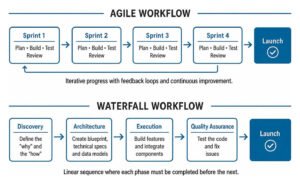
Before a single line of code is written, the discovery phase must define the “why” and the “how.” This involves rigorous requirements gathering. I always advocate for creating detailed technical specifications and data models at this stage. If you don’t define your API contracts early, you will spend your entire development cycle fixing integration bugs. Think of this as the foundation of your building—if the soil isn’t tested, the skyscraper will lean.
Agile Execution and Quality Assurance
Once the blueprint is set, Agile execution allows for iterative progress. Scrum cycles keep the team focused on short-term wins, but this must be paired with robust quality assurance. Automated testing and continuous integration (CI) are non-negotiable. If your code isn’t tested, it isn’t done.
Selecting the Optimal Tech Stack and Tooling
Choosing a tech stack is a balancing act between developer velocity and long-term scalability. Whether you are leaning toward a headless architecture or a monolithic framework, your choice dictates your maintenance burden for years to come.
Frontend Performance and Accessibility
In the modern web, performance is a feature. Users expect instant load times, which means prioritizing Core Web Vitals and bundle optimization. Furthermore, accessibility is not just a legal requirement; it is a mark of professional craftsmanship. Semantic markup and responsive layouts ensure that your application serves everyone, regardless of their hardware or physical abilities.
Managing Scope and Timelines in Web Development Projects
Scope creep is the silent killer of project timelines. I manage this by strictly grooming the product backlog and mapping dependencies early. If a new feature request comes in, it must be weighed against current milestones and resource allocation. Transparency with stakeholders is key; if you cannot deliver it in the current sprint, be clear about the trade-offs.
Maintaining Developer Ergonomics and Sustained Team Velocity

We often treat our hardware with more care than our bodies. We obsess over mechanical keyboards and high-refresh-rate monitors, yet we neglect the physical foundation of our workday: our posture. Sustained team velocity is impossible if your engineers are suffering from chronic back pain or foot fatigue.
Physical Health and Ergonomics for Desk-Bound Engineers
When you are standing at a desk or sitting for long hours, the kinetic chain of your body is under constant stress. Many developers find that their concentration breaks because of subtle discomfort in their lower back or legs. This is where high-quality arch support inserts become a secret weapon for productivity. By providing proper alignment for your feet, you reduce the strain that travels up through your ankles, knees, and hips. When your base is stable, your core stays engaged, and your focus remains on the screen rather than your discomfort.
Beyond footwear, consider these essential workstation adjustments:
- Monitor Height: The top third of your screen should be at eye level to prevent neck strain.
- Neutral Wrists: Ensure your keyboard and mouse placement allows for a straight wrist line.
- Active Breaks: Use a timer to stand up and stretch every 50 minutes.
- Lumbar Support: Use a chair that maintains the natural curve of your spine.
Preventing Burnout and Managing Technical Debt
Burnout is often the result of “death marches”—periods of unsustainable pacing. I prioritize refactoring cycles as part of the sprint to keep technical debt low. If the codebase is clean and the team is physically supported, the work remains sustainable. Mental bandwidth is a finite resource; don’t waste it on avoidable frustration.
Post-Launch Maintenance, Security, and Scalability
Deployment is not the end; it is the beginning of the application lifecycle. Monitoring telemetry and uptime tracking are vital to catch issues before your users do. Security patching should be automated, and your disaster recovery plan should be tested regularly. A system that scales is a system that is monitored.
Frequently Asked Questions About Web Development Projects
How do teams estimate timelines accurately for complex digital builds?
Accurate estimation relies on historical velocity and story pointing. By breaking down large features into smaller, manageable tasks and mapping out dependencies, teams can provide realistic delivery windows rather than optimistic guesses.
What are the best practices for minimizing technical debt early on?
Modular architecture and strict peer reviews are your best defense. When every pull request is scrutinized for quality and test coverage, you prevent “quick and dirty” code from becoming a permanent part of your system.
How does developer physical wellness impact project delivery schedules?
Physical wellness is directly tied to cognitive endurance. When developers are free from the distraction of physical pain—often addressed through better ergonomics and the use of supportive tools like arch support inserts—they experience fewer “flow state” interruptions, leading to higher quality code and fewer errors.
Conclusion
Navigating a modern web development project requires a blend of technical foresight and human-centric management. By establishing a clear architectural vision, maintaining a rigorous quality standard, and—crucially—investing in the physical well-being of the team, you ensure that your projects are not only successful but sustainable. The best code is written by people who feel their best. Take the time to build a solid foundation for your project, and an even stronger one for yourself.