




The Synergy of Managed IT and Cloud Communications
The modern business landscape, particularly in Clearwater, increasingly relies on a seamless blend of robust IT infrastructure and agile communication systems. The rise of hybrid work models, where employees operate from various locations, has underscored the critical need for network stability and efficient infrastructure management. Managed IT services, when integrated with cloud communications, offer a powerful solution to these challenges. This synergy allows businesses to consolidate vendors, reduce complexity, and achieve remarkable operational agility.
Understanding Core Infrastructure and VoIP Integration
At the heart of integrated managed services lies the core IT infrastructure, which must be meticulously managed to support advanced communication technologies. Voice over Internet Protocol (VoIP) systems and unified communications (UC) platforms are now standard for businesses seeking enhanced collaboration and cost-efficiency. However, the successful implementation of these tools hinges on a stable and well-optimized network.
For instance, VoIP systems require sufficient network bandwidth and carefully configured Quality of Service (QoS) policies to ensure crystal-clear calls and uninterrupted service. Without proper management, calls can suffer from latency, jitter, or dropped connections, undermining productivity.
Managed service providers (MSPs) in Clearwater assess existing network capabilities, recommend necessary upgrades, and implement QoS to prioritize voice and video traffic. This proactive approach ensures that cloud telephony solutions operate flawlessly, providing reliable communication channels for your team and clients.
Unifying Connectivity with Managed IT and Cloud Communications Architecture
A fragmented approach to IT and communications can lead to inefficiencies, increased costs, and security vulnerabilities. This is where the single-provider model for managed services truly shines. By entrusting both IT infrastructure and cloud communications to one expert partner, Clearwater businesses can benefit from a unified architecture.
The foundation of this unified approach often involves structured cabling, which ensures that all network components—from data servers to VoIP phones—are connected efficiently and reliably. Many local providers, such as OBTS Solutions (though based in Orlando, their approach to “One Network Architecture” is a good example of this integration philosophy), emphasize designing and installing comprehensive low-voltage systems that converge voice, data, video, and security onto a single intelligent network.
This convergence not only optimizes uptime but also simplifies troubleshooting and maintenance. Furthermore, a single provider often means simplified billing, replacing multiple invoices with one predictable monthly statement, which significantly streamlines financial management.
Key Components of Modern Managed Technology Services
Modern managed technology services in Clearwater extend far beyond simple break/fix solutions. They encompass a suite of proactive, comprehensive services designed to ensure system reliability and operational continuity. These key components include proactive maintenance, continuous remote monitoring, and accessible help desk support, all working in concert to prevent issues before they impact your business.
Proactive Monitoring, 24/7 SOC, and Incident Response
One of the most critical differentiators of managed services is their proactive nature, particularly in cybersecurity. Clearwater businesses face an ever-evolving threat landscape, making 24/7 monitoring and rapid incident response indispensable.
Many managed service providers now offer a 24/7 Security Operations Center (SOC) that provides active threat detection and response. This involves continuous monitoring of network activity, leveraging Security Information and Event Management (SIEM) logging to identify anomalous behavior. Automated patching ensures that all systems are up-to-date with the latest security fixes, closing potential vulnerabilities.
Endpoint security solutions protect individual devices from malware and other threats, while specialized ransomware protection strategies are deployed to safeguard critical data. This comprehensive approach means that potential cyber threats are often identified and neutralized before they can cause significant damage, offering peace of mind to business owners.
Optimizing Microsoft Azure and Microsoft 365 Environments
As businesses increasingly adopt cloud platforms, the management of these environments becomes a specialized task. Managed services in Clearwater play a crucial role in supporting cloud migration and the ongoing optimization of platforms like Microsoft Azure and Microsoft 365. Providers assist with the seamless transition of data and applications to the cloud, ensuring minimal disruption.
Beyond migration, they offer continuous management of Azure Virtual Desktops, Microsoft Entra ID (formerly Azure Active Directory), and overall Microsoft 365 tenant management. This includes configuring user access, managing licenses, ensuring data security, and implementing cloud governance policies to maintain compliance and cost efficiency.
For healthcare organizations, specifically, managed cloud services combine 24/7 operations with healthcare-specific compliance oversight, ensuring that Azure environments meet stringent regulatory requirements like HIPAA and HITRUST.
Strategic and Financial Advantages for Business Operations
The shift to managed IT and cloud communications in Clearwater is not just about technical support; it’s a strategic business decision that offers significant financial and operational advantages. These include predictable budgeting, enhanced cost control, optimized resource allocation, and robust risk mitigation.
Comparing Predictable Monthly Pricing vs. Break/Fix Models
One of the most compelling financial benefits of managed services is the predictable monthly pricing model. Unlike the traditional break/fix model, where businesses incur unpredictable costs for emergency repairs and hourly labor, managed services typically involve a flat-rate fee.
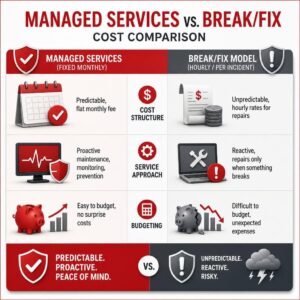
Feature Managed Services (Fixed Monthly) Break/Fix Model (Hourly/Per Incident) Cost Structure Predictable, flat monthly fee Unpredictable, hourly rates for repairs Service Approach Proactive maintenance, monitoring, prevention Reactive, repairs only when something breaks Budgeting Easy to budget, no surprise costs Difficult to budget, unexpected expenses Downtime Minimized through proactive measures Frequent, often lengthy during repairs Support 24/7 help desk, continuous support On-demand, often with delays Strategic Value IT alignment with business goals, vCIO services No strategic guidance, purely reactive Risk Reduced security risks, compliance management Higher security risks, no compliance assistance This flat-rate billing structure allows Clearwater businesses to accurately budget for their IT expenses, eliminating the dreaded surprise invoice.
It transforms IT from a variable cost center into a predictable operational expense. This model also inherently reduces overhead by minimizing emergency labor fees and, more importantly, by preventing costly downtime. For example, NetPros in Clearwater highlights that managed IT prevents problems with monitoring, updates, and backups, whereas break/fix reacts only after issues appear. This proactive stance ensures greater operational stability and financial foresight.
Enhancing Scalability with Managed IT and Cloud Communications Strategies
In today’s dynamic market, businesses in Clearwater need the flexibility to scale their operations up or down quickly. Managed IT and cloud communication strategies are inherently designed for this agility. The “pay-as-you-grow” model of cloud elasticity allows businesses to easily add or remove users, storage, and computing power as their needs evolve, without significant upfront capital investment.
This scalability extends to supporting remote onboarding for new employees, ensuring they have immediate access to necessary tools and resources regardless of their location. Managed service providers handle the infrastructure scaling, allowing internal teams to focus on core business objectives rather than IT logistics. This workflow flexibility means that businesses can adapt to new opportunities, seasonal demands, or unexpected challenges with greater ease and efficiency.
Industry-Specific Applications and Regulatory Compliance
For many industries in Clearwater, especially those dealing with sensitive data, managed services are not just about efficiency but also about meeting stringent regulatory requirements. Compliance is a non-negotiable aspect of operations, and managed service providers offer specialized expertise to navigate complex legal frameworks.

Meeting HIPAA, HITRUST, and SOC 2 Requirements
Healthcare organizations in Clearwater, for instance, face strict mandates like HIPAA (Health Insurance Portability and Accountability Act) and often pursue certifications like HITRUST (Health Information Trust Alliance) to demonstrate robust security and compliance.
Managed service providers with healthcare expertise offer tailored solutions that include audit-ready reporting, ensuring patient data protection through advanced access controls, encryption, and immutable backups. Clearwater Security & Compliance (a national provider with a strong focus on healthcare) is an example of an organization that helps healthcare entities build strong cybersecurity and compliance strategies without adding headcount, by leveraging deep expertise and purpose-built software for risk identification and management.
Similarly, for businesses handling financial transactions or sensitive customer data, SOC 2 (Service Organization Control 2) compliance is crucial. MSPs implement the necessary controls, monitor systems for compliance deviations, and provide the documentation required for audits. This specialized compliance management ensures that businesses not only meet legal obligations but also build trust with their customers and partners.
Co-Managed IT Options for Internal Technology Teams
Not all organizations in Clearwater need to fully outsource their IT. For those with existing internal IT teams, co-managed IT options offer a flexible solution. This model allows businesses to retain control over their strategic IT direction while leveraging the specialized expertise and resources of an MSP.
Co-managed IT can provide support for tier-1 ticket overflow, ensuring that routine help desk requests are handled promptly, freeing up internal staff for more complex projects. MSPs can also offer strategic guidance through virtual CIO (vCIO) services, helping internal teams with long-term IT planning, technology adoption, and cybersecurity strategy.
This collaborative approach allows businesses to augment their internal IT capabilities, gaining access to specialized expertise in areas like cybersecurity, cloud management, or compliance, without the cost of hiring additional full-time staff. Local providers like BCA and NetPros explicitly offer co-managed IT services, allowing internal teams to focus on strategy while the MSP handles day-to-day support or provides a “second pair of eyes” for critical infrastructure.
Frequently Asked Questions about Managed Technology Solutions
How do managed services differ from traditional break/fix IT support?
The fundamental difference lies in approach and cost. Traditional break/fix IT support is reactive: you call a technician only when something is broken, and you pay for their time and parts to fix that specific issue. This model often leads to unpredictable expenses, extended downtime, and a constant cycle of crisis management.
In contrast, managed IT services are proactive. For a fixed monthly fee, your provider continuously monitors your systems, performs regular maintenance, applies patches, and actively works to prevent issues before they arise. This includes proactive cybersecurity measures, data backups, and strategic IT planning. The goal of managed services is to ensure continuous operation, minimize downtime, and provide a stable, secure IT environment, offering predictable costs and greater peace of mind.
What role do cloud communications play in business continuity?
Cloud communications are vital for business continuity and disaster recovery. By hosting communication tools like VoIP, video conferencing, and messaging in the cloud, businesses gain geo-redundancy, meaning their services are distributed across multiple data centers. If a local outage or disaster occurs, communication can seamlessly failover to another location, ensuring uninterrupted voice and data services.
Furthermore, cloud communications facilitate remote access, allowing employees to stay connected and productive from anywhere with an internet connection. This is crucial during emergencies or for supporting hybrid work models. Combined with robust data backup and recovery strategies, cloud communications ensure that your business can continue to operate and communicate effectively, even in adverse circumstances.
How can organizations evaluate and select the right managed service provider?
Choosing the right managed service provider in Clearwater requires careful evaluation. Here are key factors to consider:
- Expertise and Certifications: Look for providers with demonstrated expertise in your industry and specific technologies you use (e.g., Microsoft Azure, HIPAA compliance). Check for relevant certifications.
- Response Times and SLAs: Inquire about their Service Level Agreements (SLAs) for response times, resolution times, and uptime guarantees. Prompt support is critical.
- Proactive vs. Reactive Approach: Ensure they offer comprehensive proactive monitoring, maintenance, and cybersecurity services, not just reactive support.
- Security and Compliance Focus: Verify their capabilities in threat detection, incident response, and their understanding of regulatory requirements pertinent to your business (e.g., HIPAA, PCI, SOC 2).
- Technology Stack: Understand the tools and platforms they use. Do they align with your current and future technology needs?
- Client Reviews and References: Ask for client testimonials and references to gauge their customer service and reliability.
- Pricing Model Transparency: Ensure their pricing is clear, comprehensive, and aligns with your budget expectations.
- Local Presence and Support: For Clearwater businesses, a local presence can mean faster onsite support when needed.
- Co-Managed Options: If you have an internal IT team, confirm they offer flexible co-managed solutions.
By thoroughly evaluating these aspects, businesses can select an MSP that acts as a true strategic partner, supporting their growth and operational stability.
Conclusion
For businesses in Clearwater, embracing managed IT and cloud communications is no longer an option but a strategic imperative. These integrated services offer a comprehensive solution to the complexities of modern technology, moving beyond reactive fixes to deliver proactive, secure, and scalable IT environments. From safeguarding sensitive data with 24/7 threat detection to ensuring seamless communication through optimized cloud telephony, managed services provide the backbone for operational efficiency and sustained growth.
By partnering with the right managed service provider, businesses can achieve predictable budgeting, leverage specialized expertise without expanding internal headcount, and ensure compliance with critical industry regulations. This strategic partnership empowers organizations to focus on their core competencies, knowing their IT infrastructure is in expert hands. In an increasingly digital and competitive landscape, investing in managed services is investing in a future-proof infrastructure and a significant competitive advantage for your Clearwater business.