




Core Pillars of Business Financial Management and Valuation
Effective business financial management is far more than just balancing the books; it’s about making strategic decisions that enhance and protect your company’s value. Valuation, in turn, provides the critical lens through which these decisions are assessed. Together, they form an indispensable framework for sustainable growth and successful transitions.
Aligning Strategic Decision-Making with Firm Value
At the heart of robust business financial management lies corporate finance, a discipline focused on maximizing shareholder wealth through sound investment, financing, and dividend policies. Every decision, from allocating capital to new projects to determining the optimal debt-equity mix, directly impacts a company’s long-term value.
When considering new investments, for instance, we must establish appropriate “hurdle rates.” This isn’t a one-size-fits-all number; rather, it’s a minimum acceptable rate of return that reflects the project’s inherent risk and the financing mix (debt versus equity) used to fund it. Projects that fail to clear this hurdle should ideally be reconsidered or rejected, as they would diminish, rather than enhance, firm value.
The financing decision revolves around crafting an optimal capital structure—the right blend of debt and equity. A well-managed debt-equity mix can maximize firm value by leveraging tax shields associated with interest payments, while carefully balancing the increased risk of financial distress. Similarly, a clear dividend policy guides when and how to return cash to owners. If a business consistently generates more cash than it can profitably reinvest in projects exceeding its hurdle rate, returning that excess cash through dividends or share buybacks becomes a value-maximizing decision. These principles apply universally, whether for a small, privately-held enterprise or a multinational corporation, underscoring their foundational importance in business financial management.
Integrating Business Financial Management and Valuation Frameworks
The effectiveness of any valuation hinges on the quality and integrity of the underlying financial data, which is where diligent financial reporting becomes paramount. Accurate financial statements—the balance sheet, income statement, and cash flow statement—serve as the bedrock for understanding a company’s past performance and projecting its future potential.
We emphasize the importance of “earnings quality.” This refers to how well a company’s reported earnings reflect its true economic performance. Often, financial statements require normalization to adjust for non-recurring items or accounting choices that might obscure the sustainable operating results. For example, a one-time sale of an asset or an unusually high owner’s compensation might distort profitability metrics, making it difficult to assess the business’s true earning power.
Beyond historical data, effective working capital management is also crucial. Decisions related to inventory levels, accounts receivable, and accounts payable are not merely operational; they are investment decisions that impact cash flow and, consequently, valuation. A business that efficiently manages its working capital can free up cash that can be reinvested or returned to owners, directly contributing to value creation.
A seamless integration between robust financial management practices and valuation methodologies ensures that strategic decisions are grounded in accurate, insightful data. Maintaining meticulous financial records, often supported by professional bookkeeping services, is the first critical step in this integrated approach, providing the transparency and reliability necessary for precise valuation and informed decision-making.
The Three Primary Business Valuation Methodologies
Determining a business’s worth is both an art and a science, blending quantitative analysis with qualitative judgment. While no single method provides a definitive answer, professional valuers typically employ three main approaches to triangulate a fair value range.
The Income Approach: Discounted Cash Flow and Capitalization
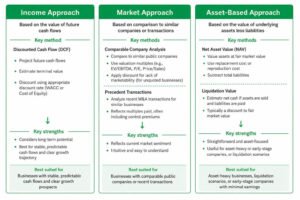
The income approach is arguably the most fundamental valuation method, as it directly relates a business’s value to its ability to generate future economic benefits. This approach determines intrinsic value based on projected future cash flows, discounted back to their present value.
The most widely used technique under the income approach is Discounted Cash Flow (DCF) analysis. This involves:
- Projecting Future Cash Flows: We forecast the company’s free cash flows (cash available to all capital providers) for a specific period, typically 5-10 years, based on detailed financial projections and strategic plans.
- Calculating Terminal Value: Beyond the explicit forecast period, we estimate a “terminal value” representing the value of all cash flows extending into perpetuity. This is often calculated using the Gordon Growth Model (assuming a constant, sustainable growth rate) or an exit multiple (applying a multiple to a projected financial metric like EBITDA at the end of the forecast period).
- Discounting Cash Flows: All projected future cash flows, including the terminal value, are then discounted back to the present using an appropriate discount rate. This rate, often the Weighted Average Cost of Capital (WACC) or the Cost of Equity, reflects the riskiness of the cash flows and the company’s capital structure.
DCF is particularly well-suited for businesses with stable, predictable cash flows and a clear growth trajectory. It provides a comprehensive view of value by considering a company’s long-term potential.
The Market Approach: Comparable Company Analysis and Precedent Transactions
The market approach, also known as relative valuation, estimates a business’s value by comparing it to similar assets that have recently been sold or are currently trading in the market. This approach operates on the principle that similar businesses should trade at similar multiples of their financial metrics.
Two primary techniques are employed here:
- Comparable Company Analysis (“Comps”): We identify publicly traded companies that are similar in industry, size, growth prospects, and risk profile to the target business. We then calculate valuation multiples for these comparable companies (e.g., Enterprise Value/EBITDA, Price/Earnings (P/E) ratio, Price/Sales). The average or median of these multiples is then applied to the target company’s corresponding financial metrics to derive a value. For unquoted companies, it’s common to apply a discount to account for lack of marketability, as public company shares are inherently more liquid.
- Precedent Transactions: This method involves analyzing the multiples paid in recent merger and acquisition (M&A) transactions for businesses similar to the one being valued. This provides insight into what strategic or financial buyers have historically been willing to pay for comparable companies. Precedent transactions often reflect control premiums, as buyers typically acquire a controlling stake.
The market approach is intuitive and reflects current market sentiment. However, its effectiveness relies heavily on finding truly comparable companies or transactions and making appropriate adjustments for differences.
The Asset-Based Approach: Net Asset Value and Liquidation Value
The asset-based approach focuses on the fair market value of a company’s underlying assets, minus its liabilities. This method is often applied in specific scenarios, such as valuing asset-heavy businesses (e.g., manufacturing, real estate), for liquidation purposes, or for early-stage companies with minimal earnings.
Key considerations within this approach include:
- Net Asset Value (NAV): This typically involves valuing each of a company’s assets (tangible assets like property, plant, and equipment, as well as intangible assets like patents or brand equity) at their fair market value, then subtracting total liabilities. This can involve using replacement cost (the cost to replace an asset with a new one of similar utility) or reproduction cost (the cost to recreate an exact replica).
- Liquidation Value: This is a more conservative measure, estimating the net cash that would be realized if a business were to sell all its assets individually and pay off its liabilities in a forced or orderly liquidation. It often reflects a discount from fair market value due to the urgency of the sale.
While straightforward, the asset-based approach can underestimate the value of a going concern, as it often doesn’t fully capture the earning power or synergistic value of a business operating as a unified entity. It’s particularly useful when a business’s value primarily resides in its physical assets rather than its future cash flow generation.
To provide a clearer perspective, here’s a comparative overview of these three primary valuation approaches:
Key Drivers, Adjustments, and Valuation Multipliers
Beyond the methodologies themselves, several critical factors and necessary adjustments significantly influence a company’s ultimate valuation. Understanding these nuances is vital for arriving at a credible and defensible assessment of worth.
Risk, Discount Rates, and Growth Assumptions
Risk is a fundamental determinant of value. Higher perceived risk generally leads to a lower valuation, as investors demand a greater return for bearing that risk. This relationship is primarily captured through the discount rate used in the income approach.
The discount rate, whether it’s the Weighted Average Cost of Capital (WACC) or the Cost of Equity, incorporates various risk components:
- Risk-Free Rate: The return on a theoretically risk-free investment, such as government bonds.
- Equity Risk Premium: The additional return investors expect for investing in the stock market over risk-free assets.
- Beta: A measure of a company’s systematic risk—how much its stock price tends to move relative to the overall market.
- Size Premium: Smaller companies often face higher risks and thus typically require a higher expected return.
- Company-Specific Risk: Unique risks attributable to the individual business, such as reliance on a single customer, management depth, or competitive landscape.
Similarly, growth assumptions play a pivotal role. Realistic and supportable growth rates for revenue and cash flows are essential. Overly optimistic projections can inflate a valuation, while excessively conservative ones can undervalue a thriving business. Factors like inflation and forecast uncertainty also need careful consideration, as they can significantly impact the reliability of future projections.
Control Premiums and Discounts for Lack of Marketability (DLOM)
Not all ownership stakes are valued equally. The ability to control a business, or the lack thereof, significantly impacts its value.
- Control Premium: When an investor acquires a majority or controlling stake in a company, they typically pay a “control premium.” This premium reflects the value of being able to influence strategic decisions, appoint management, and direct the company’s operations. This is often seen in M&A transactions where the buyer gains full control.
- Discounts for Lack of Marketability (DLOM): Conversely, shares in privately held companies or minority stakes in any business are often subject to a “discount for lack of marketability.” This discount accounts for the difficulty and time it might take to sell an ownership interest that isn’t publicly traded. For unquoted companies, this discount can be substantial, sometimes ranging from 33% to 50% of the value derived from publicly traded comparables, reflecting the illiquidity and limited access to information.
- Minority Discount: A “minority discount” is applied to non-controlling interests because minority shareholders have limited voting power and cannot unilaterally influence company decisions or extract cash flows.
These adjustments are crucial for accurately reflecting the specific nature of the ownership interest being valued.
Financial Normalization and SDE Adjustments
To ensure a valuation is based on a true picture of a company’s ongoing operational performance, financial statements often require “normalization.” This process involves adjusting historical financial data to remove the impact of non-recurring, non-operating, or discretionary items that are unlikely to continue in the future or are specific to the current owner.
Common normalization adjustments include:
- Non-Recurring Expenses/Income: Removing one-time legal fees, extraordinary gains or losses from asset sales, or unusual severance packages.
- Owner’s Compensation and Benefits: Adjusting owner salaries and perks to market rates, especially in small businesses where owners might pay themselves above or below market value, or run personal expenses through the business.
- Related Party Transactions: Ensuring transactions with affiliated entities are at arm’s length.
- Discretionary Expenses: Eliminating or adjusting expenses that are not essential to the core operation of the business, such as excessive travel, entertainment, or charitable contributions that a new owner might not incur.
For small businesses, a commonly used metric is Seller’s Discretionary Earnings (SDE). SDE starts with net income and adds back owner compensation, benefits, depreciation, amortization, interest, taxes, and any other non-recurring or discretionary expenses. This provides a clearer picture of the total financial benefit an owner-operator derives from the business, making it a more relevant earnings base for valuation multiples in small business sales.

Preparing for Liquidity, Investment, and Value Maximization
Understanding valuation isn’t just an academic exercise; it’s a practical tool for proactive financial management, especially when preparing for significant business events like seeking investment or planning an exit.
Applying Business Financial Management and Valuation to Exit Strategies
For many business owners, the ultimate goal is a successful exit, whether through a sale, merger, or generational transition. Strategic financial management and a clear understanding of valuation are paramount in maximizing the outcome of such an event.
Preparing for a sale, often termed M&A readiness, involves meticulously cleaning up financial records, optimizing operational efficiency, and demonstrating sustainable growth. Buyers, whether financial or strategic, will conduct extensive due diligence. They will scrutinize financial statements, look for recurring revenue streams, assess customer diversification (reducing reliance on a few large clients), and evaluate the strength of the management team. Businesses that can clearly articulate their value proposition, supported by robust financial data, are far more attractive and command higher valuations.
Proactive exit planning means identifying and enhancing key value drivers years in advance. This could involve investing in technology, securing long-term customer contracts, or building a strong brand identity. By consistently focusing on these areas, owners can significantly increase their company’s valuation before a sale or investment, ensuring they receive fair compensation for their years of hard work. For entrepreneurs contemplating their next chapter and seeking to maximize their return, resources dedicated to helping entrepreneurs successfully sell their businesses can provide invaluable guidance and support throughout this complex process.
Professional Appraisals vs. Internal Valuations
A crucial decision for any business owner is whether to conduct an internal valuation or engage a professional appraiser. The choice largely depends on the purpose and context of the valuation.
Internal Valuations: These are typically performed by business owners or internal finance teams for strategic planning, performance monitoring, or preliminary discussions. They are generally less formal and less costly. However, they may lack the objectivity and rigor required for external purposes.
Professional Appraisals: We recommend hiring a professional appraiser when:
- Transactions: Buying or selling a business, mergers, acquisitions, or divestitures.
- Financing: Securing significant debt or equity financing.
- Legal & Regulatory: Shareholder disputes, divorce proceedings, litigation, estate planning, or tax compliance.
- Fairness Opinions: Providing an independent assessment of the financial fairness of a transaction.
Certified appraisers hold specific credentials such as Accredited in Business Valuation (ABV) from the AICPA, Accredited Senior Appraiser (ASA), Certified Valuation Analyst (CVA), or Certified Business Appraiser (CBA). These certifications signify adherence to rigorous standards and ethical guidelines. While the cost of a professional appraiser can vary widely, typically ranging from $5,000 to $20,000 and up depending on the complexity and scope, the investment ensures a credible, defensible, and unbiased valuation report.
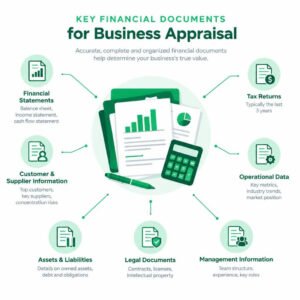
To facilitate any formal appraisal, whether internal or external, gathering comprehensive documentation is essential. Here are the key documents typically required:
Frequently Asked Questions About Business Valuation
We often encounter common questions from business owners and managers regarding the intricacies of valuation. Here, we address some of the most frequent inquiries.
What is the difference between intrinsic value and market value?
Understanding the distinction between intrinsic value and market value is fundamental in financial analysis.
- Intrinsic Value: This represents the true, underlying economic worth of a company or asset, based on a thorough fundamental analysis of its financial performance, future cash-generating capabilities, and risk profile. It’s what an asset should be worth, derived from objective data and projections. The income approach, particularly DCF, aims to calculate intrinsic value.
- Market Value: This is the current price at which an asset is trading in the marketplace. It reflects the collective perception of buyers and sellers, influenced by supply and demand, investor sentiment, macroeconomic factors, and liquidity. Market value is what an asset is currently worth according to the market. While ideally, market value should converge with intrinsic value over time, discrepancies can arise due to market inefficiencies, speculative bubbles, or external events.
Intrinsic value is a calculated estimate of true worth, while market value is the price observed in an actual transaction or trading environment.
How much does a professional business valuation typically cost?
The cost of a professional business valuation can vary significantly, primarily influenced by the complexity of the business, the purpose of the valuation, and the experience and credentials of the appraiser. As a general guideline, you can expect professional appraiser fees to range from $5,000 to $20,000 and potentially higher for very large or complex companies.
Factors influencing the cost include:
- Scope of Work: A limited scope valuation for internal planning will be less expensive than a comprehensive, fully documented report required for litigation or a major M&A transaction.
- Business Complexity: Companies with multiple divisions, complex capital structures, numerous intangible assets, or international operations will incur higher costs.
- Data Availability: If financial records are incomplete or require extensive normalization, the appraiser’s work will be more time-consuming and costly.
- Appraiser Credentials: Highly credentialed appraisers (e.g., ABV, ASA) often command higher fees due to their specialized expertise and adherence to strict professional standards.
While it represents an investment, a professional valuation provides an unbiased, defensible assessment of value that can be crucial for critical business decisions.
How often should a growing company update its business valuation?
For a growing company, a business valuation shouldn’t be a one-time event but rather an ongoing process. We recommend updating a valuation at least annually. This regular review allows owners and management to track value creation, identify areas for improvement, and ensure strategic decisions are aligned with maximizing worth.
Beyond annual updates, it’s particularly important to re-value a business after any major event or significant change, such as:
- Major Milestones: Achieving significant revenue targets, securing large contracts, or launching new product lines.
- Funding Rounds: Before seeking new equity investment or debt financing.
- Ownership Transitions: Planning for a sale, partnership changes, or succession.
- Significant Market Shifts: Changes in industry trends, competitive landscape, or economic conditions that impact the business’s prospects.
- Leadership Changes: Appointment of a new CEO or key executive.
Regular valuations provide a dynamic benchmark, offering critical insights into how management decisions, market forces, and operational changes are impacting the company’s economic value. This continuous measurement is a cornerstone of effective financial stewardship and strategic growth.
Conclusion
Navigating the complexities of business financial management and valuation is a continuous journey, not a destination. From aligning strategic decisions with firm value to understanding the nuances of income, market, and asset-based approaches, every aspect plays a crucial role in shaping a company’s destiny. We’ve explored how risk, growth, and specific adjustments like control premiums and normalization impact the ultimate assessment of worth.
Successful businesses are those that embrace financial management as a proactive tool for value creation. By regularly assessing your company’s worth, understanding its key value drivers, and preparing diligently for future transitions, you are not just managing finances—you are actively building a legacy. Valuation is both an art and a science, requiring quantitative rigor blended with qualitative judgment. With a solid grasp of these principles, you can confidently steer your business toward sustained growth, successful investment, and a rewarding exit when the time is right.