



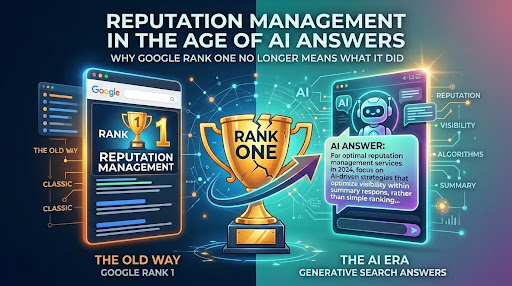
For years, ranking first on Google was the gold standard of online visibility. If your brand held that top spot, you controlled the first impression. Reputation management services were built around that logic, and for a long time, it worked.
That logic is now incomplete.
AI-powered search tools like ChatGPT, Perplexity, and Google’s AI Overviews have changed where people go for answers. They’re not always clicking ten blue links. They’re reading a synthesized response generated from dozens of sources, and your carefully optimized page one ranking may not appear in that response at all.
What Changed in Search, and Why It Matters for Your Brand
The shift isn’t subtle. A growing share of search behavior now happens inside AI interfaces. A user asks ChatGPT about the best PR crisis firms, or asks Perplexity whether a company is trustworthy, and receives an answer that names specific brands, cites specific sources, or simply omits others entirely.
Ranking first on Google doesn’t guarantee you’re mentioned in that answer. And if you’re not mentioned, you don’t exist in that interaction.
This is particularly relevant for reputation management. People researching a brand, executive, or professional don’t just want a list of links. They want a verdict. AI tools are increasingly delivering one.
How AI Search Engines Decide What to Say About You
AI answers are not random. They’re drawn from content that AI models have indexed, trusted, and treated as credible. Several factors influence whether your brand gets cited, ignored, or described unfavorably.
The main ones are:
- Authority signals: Is your brand mentioned on credible, high-domain sites?
- Consistency: Do multiple sources say the same things about you?
- Structured, quotable content: Are your claims written in ways that are easy for an AI to extract and reuse?
- Sentiment across sources: What do reviews, news coverage, and third-party content say?
A brand can rank first on Google for its own name and still be described negatively by an AI tool because the underlying web of sources tells a different story.
Generative Engine Optimization Is Not a Rebrand of SEO
Generative engine optimization, often abbreviated as GEO, is the practice of optimizing content and brand presence so that AI systems accurately and favorably reference your brand in generated responses.
GEO and SEO overlap in some areas. Both care about authoritative sources, quality content, and consistent information. But GEO introduces requirements that traditional SEO didn’t emphasize.
Where SEO focused heavily on keyword placement and click-through, GEO focuses on:
- Writing factual, structured statements that AI can lift and cite
- Building a broad footprint of consistent brand mentions across independent sources
- Ensuring your owned and earned content answers the questions people are actually asking AI
The brands winning in AI search aren’t necessarily the ones with the best-optimized page titles. They’re the ones whose reputation story is coherent, consistent, and credible across the web.
The Role of Reputation Management Services in This New Environment
Reputation management services now operate across two parallel tracks: traditional search results and AI-generated answers.
Managing your brand’s presence in AI answers requires attention to the same raw material that shapes them: third-party coverage, review platforms, Wikipedia entries, forum discussions, news articles, and structured content on your own site. What AI tools say about your brand is essentially a reflection of what the broader web says.
Companies like NetReputation have documented how AI systems pull from the same reputation signals that have always mattered, including reviews, news coverage, and third-party citations, but weight them differently than traditional search algorithms do.
The practical implication is that reputation work has to go broader and deeper than it once did. A clean Google search result page is necessary, but it’s no longer sufficient.
Why AI Answers Are Particularly High Stakes for Reputation
When someone Googles your name, they see a mix of results. They can scroll, click, and form their own opinion from multiple sources. When someone asks an AI about your brand, they often receive a single synthesized answer. There’s no scrolling through page two.
That concentration of influence makes accuracy more important, and errors more damaging. If an AI tool has absorbed outdated, incorrect, or negative information about your brand, it may confidently repeat that information without attribution to every user who asks.
Correcting the record in AI search is harder than updating a meta description. It requires changing the underlying web of sources the AI draws from.
What Reputation Management Looks Like Now
Effective reputation management in this environment means treating content as infrastructure. Every piece of owned content, every earned mention, every review response is a data point that AI systems may eventually use.
Specific practices that matter now:
- Publishing factual, structured content that clearly defines who you are, what you do, and how you’re positioned
- Building third-party coverage on credible sites that can serve as AI citations
- Monitoring AI outputs for your brand name across major platforms, not just tracking Google rankings
- Maintaining review volume and recency across platforms, since reviews are among the most commonly cited sources in AI answers about businesses
- Correcting misinformation at the source, because AI tools can’t update their responses until the underlying sources change
The brands most exposed right now are those that invested heavily in SEO while treating everything else as secondary. A strong keyword strategy won’t protect you from an AI tool that has absorbed three years of negative press and review patterns.
Reputation Management Services Must Account for Both Audiences
Every piece of content and every off-site mention now serves two audiences simultaneously: human readers using traditional search and AI systems pulling data for generated responses.
Writing for both isn’t complicated, but it requires intentionality. Clear factual statements, structured explanations, and authoritative third-party citations serve humans and AI equally well. Vague brand messaging and keyword-stuffed landing pages serve neither.
The brands that will maintain strong reputations in AI-driven search are those that treat reputation management as a content and distribution strategy, not just a suppression or monitoring exercise.
Rank one still matters. It’s just no longer the whole answer.