



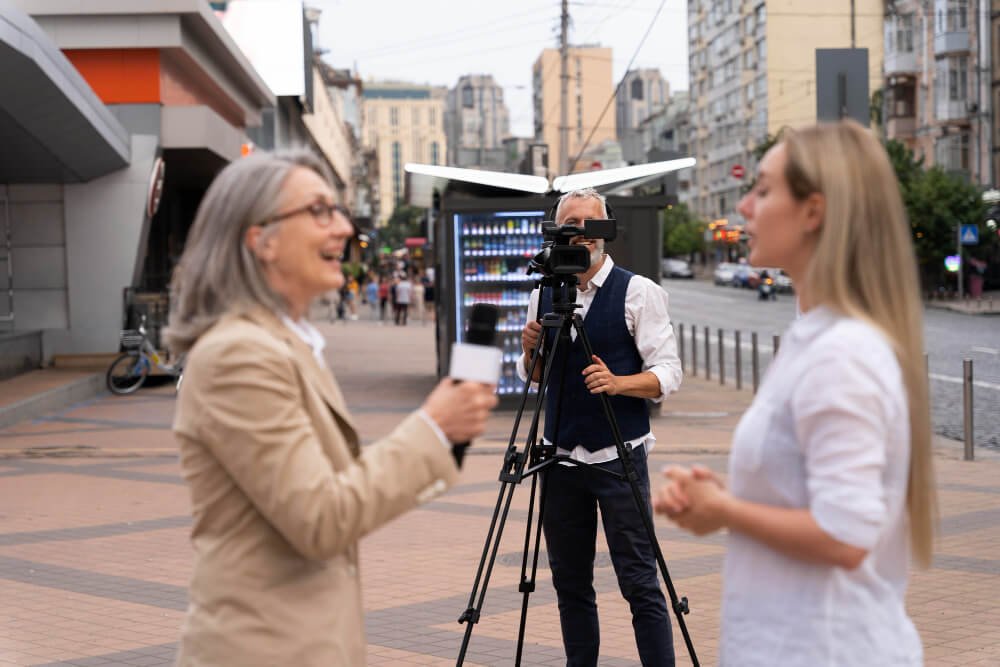
A street interview becomes much easier to plan when the product gives the person on camera something interesting to do.
Hand someone a drink and they can taste it. Give them two fragrances and they can compare them. Show them a physical product with an unusual feature and they can test it in front of the camera. An app, financial service, or subscription is harder. There may be nothing useful to hold, taste, smell, or wear, so the conversation has to establish a behavior, frustration, preference, or problem before the company has a natural reason to appear.
Brands comparing street interview companies should therefore look past the visible format. The interviewer, microphone, participant, captions, and vertical edit may look similar from one campaign to another, but the useful advertising comes from what happens underneath. The question has to suit the product, the participant needs a reason to respond, and the interaction has to produce footage that still makes sense once it reaches a paid or organic social feed.
The companies below all work with street interviews, vox pops, or closely related public interview production. They differ in how much control they give the advertiser, how they work with participants, what happens after filming, and the types of consumer products their production models can accommodate.
1. Street Poller Media
Street Poller Media specializes in turning public conversations into advertising creative. Its current portfolio spans CPG and ecommerce, food and beverage, technology and apps, finance, wellness, and other consumer categories, giving the company experience with products that create very different situations on the street.
The interview mechanism changes with the product. Street Poller’s published consumer work includes blind taste tests, product trials, demonstrations, trivia, questions built around consumer problems, comparisons, delayed product reveals, rapid reaction edits, and longer conversations. A physical product can enter through direct experience, while an app or service may need the interviewer to begin with something the participant already does or cares about.
Its CPG and ecommerce portfolio provides useful examples of street interview ads built around different types of consumer interaction. Street Poller publishes work involving blind taste tests for Rav & Co, supplement trials for Health Y Sol, skincare related tests and trivia for Born To Be Free, and other consumer campaigns. The company also publishes performance figures for these engagements, including revenue, ROAS, acquisition, and view metrics. Those results are reported by Street Poller from individual client campaigns and should not be interpreted as expected results for another advertiser.
The production model extends past capturing responses. Street Poller develops questions and concepts, films public interactions, creates multiple pieces of creative from the footage, and offers paid media and creative testing services. For consumer brands running advertising rather than simply filling an organic content calendar, the shoot can be planned around several concepts and hooks instead of a single finished interview.
Street Poller’s own 2026 material makes broader claims about the scale and comparative performance of street interview advertising. Those claims originate with the company. The stronger reason to consider Street Poller in this comparison is easier to verify: its published portfolio shows a substantial range of consumer products and several different ways of putting those products into real public conversations.
2. Sidewlk Studios
Sidewlk Studios is a Los Angeles production company built specifically around street interview advertising for direct to consumer brands. Its work is particularly suited to products that can create an immediate physical experience.
The studio’s portfolio covers categories such as beverages, fragrance, apparel, skincare, wellness, and other consumer goods. Instead of asking participants to describe a product they barely know, the format can give them something to taste, smell, wear, inspect, or try while the camera records what happens.
When the product itself creates an event, the question does not have to carry the entire video. Someone trying an unfamiliar drink can respond to taste, expectation, preference, comparison, or purchase interest while viewers watch the experience unfold.
Sidewlk says it films real strangers rather than actors, with participants compensated as intercepts and asked to sign releases. Its current production information also covers usage rights, multiple interviews, editing, and a planning process that aligns the concept, questions, location, and messaging before filming. The studio is based in Los Angeles and works with direct to consumer brands nationally.
Its published Net Hydrate material reports millions of earned views, multiple hooks produced during the campaign, and advertising performance results. Those figures describe Sidewlk’s reported results for that particular client rather than what another consumer product should expect from street sampling.
For physical products, the practical question is whether trying the item creates a response worth watching. Sidewlk’s production model is naturally suited to situations where that answer can emerge visibly in front of the camera.
3. Interview Media
Interview Media builds its campaigns around a deceptively simple starting point: one question.
The company develops a brand’s product, launch, or message into something members of the public can answer, takes that question onto the street, and turns the strongest responses into short social edits. Finished content can be prepared for TikTok, Instagram Reels, YouTube Shorts, X, owned channels, paid media, or distribution through Interview Media’s own network.
For consumer brands, this question centered approach can create continuity across a series without requiring every participant to say roughly the same thing. One person may agree with the premise, another may reject it, and a third may interpret the subject in a completely different way. The campaign retains a recognizable idea while the individual conversations change.
The difficulty is choosing a question that does commercial work without making the preferred answer obvious. “Would you buy this amazing new product?” leaves very little room for an interesting conversation. Asking about an existing habit, frustration, preference, or category assumption can produce considerably richer material.
Interview Media says it handles the question, filming, editing, and distribution. Its current site also publishes average view and output figures, but those company supplied metrics are not necessary to understand the production model. The useful distinction is the way a central question acts as the organizing device for the campaign.
That structure can suit a consumer brand developing an ongoing interview series around a recognizable subject rather than publishing a collection of unrelated street clips.
4. StreetInterviewVideos
StreetInterviewVideos is useful to examine because it does not require every campaign to use the same type of street interview.
The company currently offers two distinct production routes. Brands can film real strangers answering without a script or use an actor led production when the advertising requires greater control over the message. Scripted, partly scripted, and unscripted approaches are available depending on the project.
Its portfolio makes the distinction visible. Current work spans ecommerce, fragrance, food, apps, branded UGC, and other consumer categories. Examples include fragrance street tests, app related interviews, physical product interactions, and scripted street style advertising.
Some consumer products benefit from uncertainty because the reaction itself carries the idea. A fragrance comparison or unfamiliar product trial may lose much of its value if every response is predetermined. Other campaigns need exact claims, tightly controlled timing, or a specific narrative that would be difficult to obtain by approaching strangers and waiting for someone to naturally deliver the required message.
StreetInterviewVideos plans around the campaign goals, audience, platforms, questions, and hooks before filming. Its current service information includes vertical production, captioned and uncaptioned edits, raw footage, and one year of paid advertising rights, with additional hook variations available depending on the project.
Brands should know which production route they are commissioning. Actor led street style creative and genuine public interviews can both be legitimate advertising formats, but viewers should not be given the impression that a scripted performance is an unsolicited consumer endorsement.
5. StreetTalk
StreetTalk works with unscripted public responses and explicitly distinguishes its format from productions using paid actors or predetermined reactions. The company calls its approach Authentic Generated Content and develops street interview material for social platforms and advertising campaigns.
Its published work covers consumer brands across beauty, personal care, food and beverage, apps, wellness, and other categories. StreetTalk’s own 2026 material discusses companies including Jones Road Beauty, Dollar Shave Club, Calm, IL MAKIAGE, Happy Viking, and Homebase in the context of street interview advertising.
One useful characteristic of the format is its ability to preserve disagreement. A conventional testimonial is normally selected because the speaker already has something positive to say about the product. A public interview can begin much earlier in the persuasion process. Someone may misunderstand the category, raise an objection, prefer a competing habit, or question the premise before the product is introduced.
Those moments become useful when the interviewer can pursue a relevant answer and the edit preserves enough context for the exchange to remain credible. A skeptical participant can sometimes reveal a consumer objection more clearly than another immediate endorsement.
StreetTalk also publishes strong claims about performance, measurement, and the effectiveness of its format. Those statements should be evaluated as evidence from the company’s own campaigns rather than universal conclusions about street interview advertising. Its documented use of real public participants and work across consumer categories provide a clearer basis for evaluating the service.
6. Vox Pops International
Vox Pops International comes from a broader interview and video research tradition rather than the newer direct response street advertising category.
The company traces its origins to the late 1980s and provides vox pops, intercept interviews, customer interviews, video research, social content, and related production. Its current service information describes on the street interviews as a way to gather opinions about brands, products, services, concepts, and everyday life. Vox pop footage can also be produced for advertising and social media content.
For some consumer brands, the objective extends past capturing an immediate product reaction. A company may want to hear how people describe a category, what language they use around a problem, how they respond to a concept, or what matters during a purchasing decision. Those conversations can inform marketing as well as become marketing material, depending on how the research and production are structured.
Vox Pops International also works internationally, making it relevant when a consumer company needs public interviews outside a single US city or wants to explore reactions in multiple markets.
Its service model is broader than that of a specialist performance advertising studio. A company seeking a frequent stream of direct response Meta ads is therefore comparing a different type of provider. Consumer research, international interviews, concept testing, and social video built around public opinion fit more naturally within the company’s wider production background.
Match the Interview to the Product Experience
Once the agency has been chosen, the next decision belongs to the product.
Consumer marketers sometimes copy an interview format because another company’s video performed well. The microphone, question style, subtitles, or editing are reproduced, but the new product gives participants nothing comparable to react to.
A better starting point is asking what a stranger can realistically experience during the interaction.
| Product Situation | What the Interview Can Capture | Main Production Challenge |
| Food or beverage | Taste, surprise, preference, comparison | The reaction needs enough context to mean something |
| Fragrance or beauty product | First impression, preference, sensory description | Sensory experiences can be difficult to communicate visually |
| Demonstrable physical product | Trial, comparison, visible result | The demonstration can overpower the conversation |
| Apparel or accessory | Fit, appearance, preference, styling reaction | Participant selection can heavily shape the response |
| App or digital product | Existing behavior, problem, demonstration, usability | There is less physical action for the camera |
| Consumer service | Frustration, habit, opinion, decision process | The company needs a credible route into the conversation |
The final two categories often require the most thought. A snack can generate a reaction within seconds. An insurance product cannot. An app may be visually demonstrable, but watching someone navigate a screen is rarely enough to carry an entire interview.
For intangible products, the human problem often needs to come first.
Five Products Walk Onto the Street
The differences become clearer when the same broad format is applied to specific consumer situations.
A New Sparkling Drink
Sampling is the obvious route, but “Do you like it?” wastes much of what the format can reveal.
A blind comparison could test preference without brand recognition influencing the answer. Asking what flavor the participant expects before tasting can create a useful before and after moment. Comparing two varieties can also reveal language the brand may later find useful in other creative.
The camera has something immediate to capture: anticipation, tasting, and response.
A Fragrance
Fragrance presents an unusual challenge because the most important part of the experience is invisible.
The participant’s language therefore becomes the visual event. What does the scent remind them of? Who would wear it? Does it feel expensive, casual, familiar, unusual, youthful, or mature?
A strong participant may describe the fragrance in language that would never appear in the brand’s formal product copy. A weak question may produce little beyond “smells good.”
A Budgeting App
Handing someone a phone and asking whether they like the interface is unlikely to produce much of a story.
The conversation could begin with behavior instead. What expense surprised them last month? Do they know how much they spend on subscriptions? How do they keep track of recurring bills?
Once the participant has described the problem in their own terms, the app has a reason to enter the exchange.
A Skincare Product
Skincare can support demonstrations and first impressions, but claims require care. An immediate reaction can show texture, packaging, scent, application, or preference. It cannot establish a long term clinical outcome simply because someone tried the product for 30 seconds on a sidewalk.
The interview concept should respect the difference between what can be observed immediately and what requires evidence over time.
A Subscription Service
There may be no physical product at all.
The strongest material may come from the behavior the service is trying to change. The interviewer can explore what people currently do, what frustrates them about it, what they pay, or what would make them consider switching.
The service then enters as a possible alternative rather than appearing unexpectedly in the middle of an unrelated conversation.
Examples Are Useful Only When You Know What to Examine
Looking at successful campaigns can help a brand understand how street interviews are constructed, but the question alone rarely explains why the creative works. Pay attention to what the participant is being asked to experience, compare, demonstrate, or discuss, and how naturally the product fits into that interaction.
Four common mechanisms illustrate the difference:
| Interview Mechanism | What Creates the Response | What Can Go Wrong |
| Blind comparison | Participant evaluates without knowing which brand is which | The reveal becomes predictable or the comparison is poorly controlled |
| First experience | A genuine immediate encounter with the product | The product produces very little visible reaction |
| Problem question | Participant describes an existing frustration or behavior | The eventual brand introduction feels forced |
| Demonstration | The product does something viewers can see | The conversation turns into a conventional product pitch |
A blind taste test makes sense when preference can genuinely be evaluated during the shoot. It makes far less sense when the differences between products require weeks of use. A first reaction can reveal something about packaging, taste, scent, appearance, or usability, but it should not be edited to imply extended product experience.
The format should follow what can truthfully happen during the interaction.
The Question Before the Question
Writing “good interview questions” is too vague to be useful. Before deciding what the interviewer should ask, the brand needs to determine what kind of response would actually help the campaign.
Suppose a company sells a sleep product. Asking strangers, “Do you care about getting enough sleep?” is unlikely to uncover much. Almost everyone understands that sleep matters.
The useful territory may sit underneath the obvious answer. What keeps people awake? What have they already tried? How much sleep do they believe they need? What do they do when they cannot fall asleep? Which solutions do they distrust?
Those questions create possible directions without telling participants what they are supposed to say.
The interviewer also needs room to listen. If someone gives an unexpected but relevant answer, the next question may be more valuable than anything written in the original brief. Preparation should establish the territory that matters to the brand without making the conversation so rigid that useful answers cannot change its direction.
Leading questions deserve particular caution. If the wording practically announces the preferred response, viewers may interpret the interaction as staged even when the participant is genuine.
What Happens to the Footage Nobody Uses?
A street shoot naturally produces material that never becomes an ad.
Some people give one word answers. Others become uncomfortable on camera. A response may repeat something already captured several times. Traffic noise can ruin otherwise useful audio. A participant can misunderstand the question, or a product trial may simply produce no interesting reaction.
Brands should therefore be careful when comparing production numbers. These terms describe different things:
- Interviews captured refers to conversations recorded during production.
- Usable responses are moments that survive basic quality and relevance checks.
- Creative concepts are genuinely different advertising ideas.
- Edited videos are completed deliverables.
- Hook variations may use much of the same underlying footage with different openings.
- Advertising assets are finished pieces prepared for campaign use.
A proposal promising 50 interviews is not necessarily offering 50 advertisements. Another agency might capture fewer participants but produce several deliberate concepts and multiple usable cuts from each.
Neither production model can be judged by the headline number alone. Brands need to know what each number in the proposal actually represents.
It is also worth asking what happens to unused material. Raw footage can have future value if the usage rights permit it. A reaction that does not fit the first campaign might become useful later, while longer answers can sometimes be recut when the brand wants to explore another message.
When Product Placement Starts Feeling Forced
Consumer street interviews often fail at the exact moment the advertiser enters the conversation.
A participant is discussing dating, travel, money, food, or another engaging subject. Suddenly the interviewer produces a product that has only a weak relationship with anything that came before it.
The problem is not necessarily that viewers object to seeing a brand. The problem is that the conversation stops making sense.
Physical product experiences can make the transition easier. If the premise is a taste comparison, the food belongs there from the beginning. If the subject is fragrance preferences, handing someone a scent is a logical next action.
Apps and services usually need a stronger conversational bridge. The participant might first describe a problem, existing habit, expense, frustration, or decision. A relevant product can then enter as something to explore rather than as an interruption.
Delayed reveals can work when the concealment serves a genuine purpose. A blind test, for example, may prevent brand familiarity from influencing the first response. Hiding the company simply to manufacture suspense does not necessarily make the eventual reveal meaningful.
The cleanest integrations make the product necessary to the interaction rather than something added after the interesting part has already happened.
Plan the Deliverables Before the Shoot
Street production can generate many types of material from the same filming session: individual reactions, compilation edits, product demonstrations, longer interviews, opening hooks, cuts centered on objections, comparison videos, organic posts, and raw footage for later editing.
What matters depends on how the brand intends to use the material. A company testing several messages may care about concept and hook variation. A brand developing an organic interview series may value complete conversations. A paid social team may want several short cuts built around different objections, while an advertiser with an internal creative team may place greater value on clean raw footage.
Usage rights matter just as much as file quantity. Content intended for paid advertising may require different permissions from material produced only for an organic brand account. Participant releases, talent arrangements, music, locations, and the agreement with the production company can all affect how the footage may be used.
Deliverables should therefore be defined according to what the brand can actually do with them, not simply how many files arrive after production.
Before Signing the Production Agreement
A useful agency conversation should get specific quickly. Consumer brands should know:
- Who develops the questions and concepts? Determine whether the agency contributes creative strategy or mainly executes a supplied brief.
- Who appears on camera? Clarify whether participants are spontaneous street intercepts, recruited respondents, compensated participants, actors, creators, or some combination.
- What rights are included? Confirm participant releases, paid advertising rights, organic usage, duration, raw footage rights, and any geographic restrictions.
- What exactly counts as a deliverable? Separate unique concepts from edits, hook variations, interviews captured, and finished advertising assets.
- What happens when the street does not cooperate? Weather, weak reactions, unusable audio, low participation, or an ineffective concept can affect a shoot. Reshoot terms should be clear before production begins.
- Can the company show relevant category work? A successful beverage sampling campaign does not automatically demonstrate expertise with an app, financial product, or complex consumer service.
Price matters, but a lower production quote can lose its advantage if the footage cannot be used in the intended media, the participants are poorly matched to the campaign, or most of the promised videos turn out to be minor variations of the same response.
Give the Stranger Something Worth Responding To
The strongest consumer street interview concepts usually have a reason for the conversation to exist before the camera starts rolling. There is something to taste, compare, try, question, demonstrate, remember, disagree with, or explain.
From there, the production company has to find suitable participants, recognize useful answers while they are happening, preserve the credibility of the interaction, and turn unpredictable footage into coherent advertising. Those decisions are what separate a collection of public reactions from material a consumer brand can actually use.
The starting point, however, belongs to the product. When the interview is built around something people can genuinely experience or have a meaningful opinion about, the brand does not have to fight its way into the conversation. It already has a reason to be there.